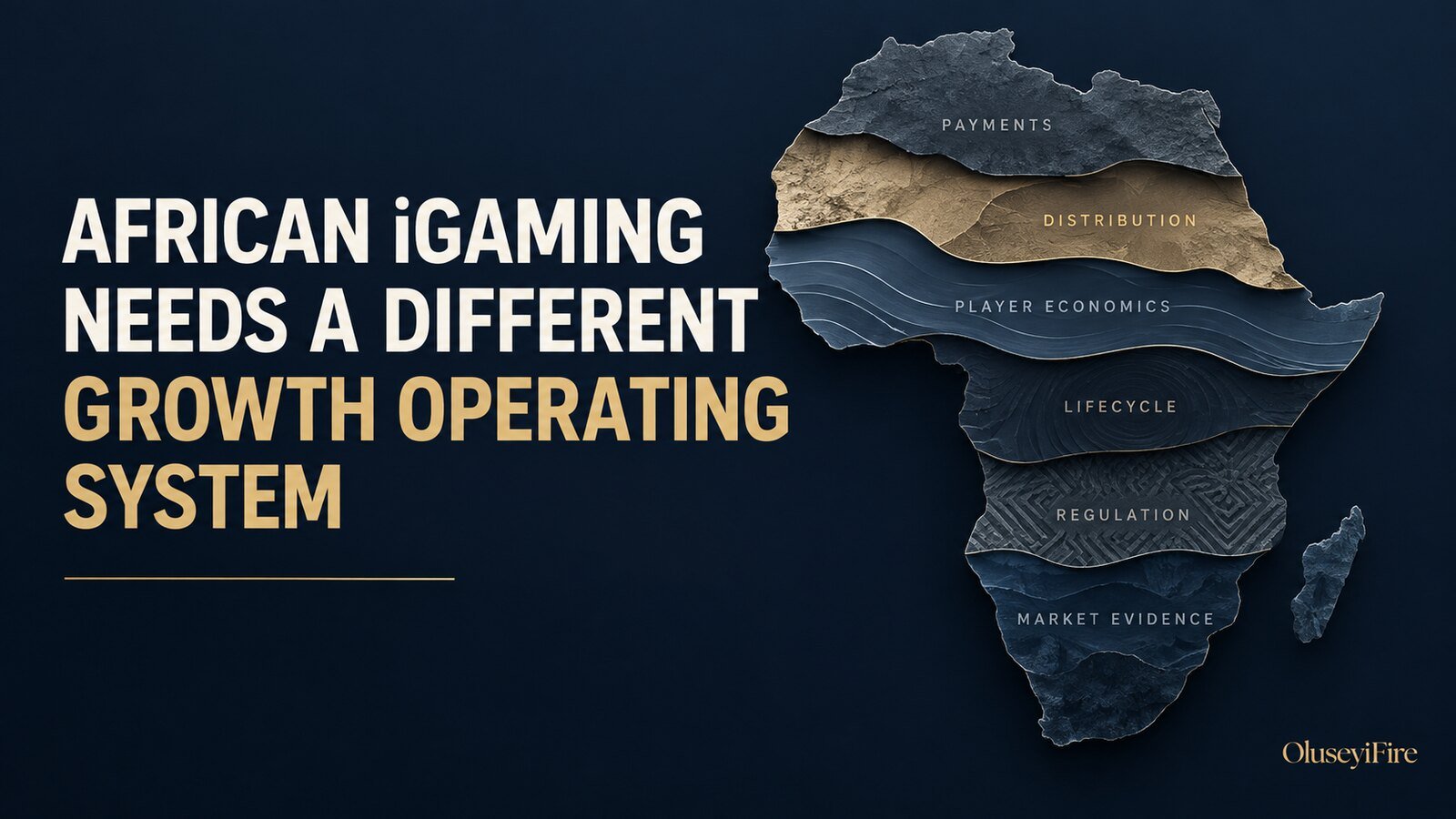
An African iGaming growth operating system cannot be a lighter version of a European growth strategy. It must be built around local payment confidence, distribution, player economics, regulation and lifecycle behaviour.
Many operators enter African markets with a familiar launch sequence. They translate a landing page, connect a payment provider, increase the welcome offer, recruit affiliates and buy media. The campaign may produce registrations, yet deposits remain inconsistent, repeat activity is weak and the acquisition team blames traffic quality.
The problem often begins before the traffic arrives. The business has imported a growth model built around assumptions that do not hold in the market it is entering.
This is not an argument that Africa is one homogeneous market. The opposite is true. My direct operating evidence in this article comes from Nigeria. Where I refer to other African markets, I rely on published regulatory and industry evidence rather than presenting research as personal operating experience.
What an African iGaming growth operating system must connect
A marketing plan decides which channels to use, what offer to promote and how much to spend. A growth operating system determines how the business learns and makes decisions after the campaign starts.
It connects six things that operators too often manage separately:
- the market assumptions behind the launch;
- the payment and withdrawal experience;
- the distribution channels that carry trust;
- the economics of acquired player cohorts;
- the lifecycle system that moves a player from registration to repeat activity;
- the regulatory rules that determine what the business can offer, communicate and scale.
If these components do not share the same evidence, the business can report strong activity while destroying value. The media team celebrates clicks. The affiliate team celebrates registrations. The CRM team sends bonuses. Finance sees weak net gaming revenue and rising acquisition cost. Each department is reading a different version of the same market.
1. Start with market truth, not a regional template
Coverage is not the same as access, and access is not the same as usable demand. The GSMA Mobile Economy Africa 2026 report says 63% of Africa’s population is covered by mobile broadband but remains offline. Device affordability, digital skills and social barriers still sit between network coverage and actual participation.
That matters because an operator can overestimate the practical size of a digital market. A person may live inside 4G coverage and still use an older device, conserve data, share a handset or avoid unfamiliar financial journeys. A product tested on fast Wi-Fi and a recent smartphone may technically load on that device while remaining commercially unusable.
The first operating discipline is therefore assumption control. Before scaling acquisition, the team should document what it believes about devices, connection quality, payment access, language, support expectations, popular bet types and trusted sources of information. Each assumption needs an observable signal that can confirm or reject it.
This turns localisation from a creative task into an operating process. Translation may be part of it, but the larger work is removing the reasons a local customer hesitates, fails or leaves.
The country-level questions that change the model
A regional market deck can be useful for deciding where to investigate. It is a weak basis for deciding how to operate. The questions that determine commercial viability sit below the regional headline.
What proportion of intended customers can complete the preferred deposit journey without assistance? Which devices produce the most registration failures? Does the market trust cards, bank transfers, mobile money, agents or cryptocurrency? How quickly do customers expect a withdrawal, and what happens to support demand when that expectation is missed? Which sports, bet types and casino products create repeat behaviour rather than one-off promotional activity?
The answers affect product configuration, staffing and economics. A market that requires more human support will carry a different service cost. A market with smaller initial deposits may require a lower acquisition ceiling even if player frequency is healthy. A market where customers learn through communities needs a different attribution approach from one dominated by searchable publisher content. A jurisdiction with fragmented licensing can make a seemingly national campaign expensive to operate legally.
These are not reasons to avoid African markets. They are reasons to replace broad optimism with specific operating evidence. The strongest local opportunity often becomes visible only after the imported assumptions have been removed.
2. Payment confidence belongs inside acquisition
In many acquisition dashboards, the payment journey begins after marketing has completed its job. The user clicked, registered and reached the cashier. Any failure from that point is treated as a payment issue.
Commercially, that distinction is false. A registration that cannot become a funded account is an acquisition failure.
From my work in Nigeria, payment confidence has repeatedly influenced whether apparent demand becomes usable revenue. Customers evaluate more than whether a payment logo is visible. They consider minimum deposit, transaction success, settlement speed, withdrawal confidence, currency familiarity and the support available when something goes wrong.
A global cashier can support cards and cryptocurrency and still be badly fitted to a local acquisition journey. A technically available method may be unfamiliar. A minimum deposit may sit above the amount a new player is comfortable testing. A default currency can make the product feel foreign. A failed first transaction can permanently destroy trust before CRM has a chance to intervene.
The growth team should therefore track the full deposit funnel by method and source: cashier opened, method selected, transaction attempted, transaction approved, first deposit completed, withdrawal attempted and withdrawal completed. Acquisition reporting should not stop at registration.
This is also why payment fit cannot be solved by adding every possible method. More options can increase complexity. The goal is a small number of dependable journeys, presented in an order that reflects local behaviour and backed by support that can resolve failure quickly.
3. Distribution must carry trust, not only reach
Imported growth plans often assume that advertising creates awareness and the product converts the resulting traffic. In Nigeria, the source introducing the product can be part of the product’s credibility.
Affiliates, creators, tipsters and closed communities do more than deliver clicks. They interpret the offer, answer questions, demonstrate deposits or withdrawals and lend their reputation to an unfamiliar operator. This does not make every community source valuable. It means the operator must evaluate the trust relationship behind the traffic, not only the size of the audience.
A large channel with weak audience confidence can underperform a smaller community whose administrator has earned attention over time. The difference may not appear in click-through rate. It appears later in first-deposit conversion, repeat deposits, net gaming revenue, chargebacks, fraud indicators and retention.
This changes partner management. Recruitment volume is not the primary goal. The system needs source verification, clear traffic rules, deal structures tied to player value and enough management capacity to understand what each meaningful partner is sending.
The question is not how many affiliates have joined. It is how many can repeatedly bring customers who understand the product, fund successfully and stay economically healthy.
4. Player economics should control acquisition
I have managed a Nigerian affiliate portfolio that generated more than $2 million in cumulative deposits, with peak monthly deposits above $400,000. The important lesson was not the headline deposit number. Commercial quality depended on maintaining an NGR margin above 40% and deal profitability above 30% across a network of more than 100 affiliates.
Those results reinforced a simple operating principle: acquisition volume is an input, not an outcome.
Two sources can produce the same number of first-time depositors and create very different businesses. One cohort may deposit once to claim an incentive and disappear. Another may start cautiously, return repeatedly and create a durable revenue stream. Paying the same effective acquisition price for both cohorts is not performance marketing. It is accounting convenience.
The operating system should compare cohorts using a common commercial view:
- registration-to-first-deposit conversion;
- average first deposit and repeat deposit behaviour;
- gross and net gaming revenue;
- bonus cost and payment cost;
- retention by product and source;
- fraud, duplicated accounts and rewarded traffic indicators;
- commission cost over the full duration of the deal.
This allows the operator to reduce spend on channels that look efficient at registration level but perform poorly after funding. It also protects partners whose customers appear more expensive initially but retain and monetise better.
5. Lifecycle systems must reflect product behaviour
Retention is often reduced to sending more messages. The result is a campaign calendar rather than a lifecycle system.
The first 14 days deserve particular attention. That is where payment uncertainty, reward misunderstanding, poor product discovery and weak support can turn an acquired customer into a dormant account.
Sportsbook, casino and crash players should not receive identical journeys. Their reasons for returning, their session patterns and the risks around their activity differ. A useful lifecycle design responds to behaviour: registration without deposit, failed deposit, first successful bet, early win, early loss, withdrawal attempt, product switching, repeated inactivity and signs of harmful play.
Channel choice also matters. Email may remain useful, but it should not be treated as the default simply because it is familiar to the operator. Push, in-product messaging, SMS and human support can be more immediate in markets where inbox behaviour is weak. The correct mix should be tested against customer response and consent, not inherited from another region.
Bonuses need the same discipline. A promotion can increase deposits while weakening the underlying cohort. Reward cost, wagering behaviour, withdrawal experience and post-bonus activity must be reviewed together.
6. Regulation is part of the growth model
Regulation is not a final legal check performed after the commercial plan is complete. It influences market selection, payment access, advertising, partner recruitment, data capture, bonuses, geolocation and the cost of operating.
Nigeria demonstrates how quickly the operating context can change. In November 2024, the Supreme Court declared the National Lottery Act inapplicable across the 36 states, while federal legislative authority remained for the Federal Capital Territory. PwC’s analysis of the judgment highlights the resulting questions around state licensing, duplicated costs, remote operators and differing compliance requirements.
That is not only a legal development. It affects growth economics. A national campaign can create customers in jurisdictions with different requirements. Affiliate contracts may need tighter controls. Market-entry sequencing may change when licensing, levies and operational obligations vary by state.
South Africa provides a different structure and a useful sourced comparison. Its National Gambling Board compiles audited data from provincial licensing authorities. The FY2024/25 national statistics reported total gross gambling revenue of approximately R74.5 billion, with betting contributing about R52.0 billion. The same report shows how market reporting and oversight are organised through provincial structures rather than a single undifferentiated national layer.
The practical lesson is that an African expansion plan must contain a regulatory operating model, not a generic compliance appendix.
The operating rhythm that makes the system useful
A framework has little value unless it changes weekly decisions. The operating rhythm should connect acquisition, payments, product, CRM, affiliate management, compliance and finance around the same cohort evidence.
A practical weekly review should answer five questions:
- Which sources produced funded players rather than registrations?
- Where did customers fail between cashier entry and successful deposit?
- Which cohorts produced healthy NGR after bonuses, payment costs and partner commission?
- Which early behaviours predicted repeat activity or rapid dormancy?
- Which regulatory, product or trust issue requires an operational change before more traffic is purchased?
The answers should lead to decisions: pause a source, reorder payment methods, revise a minimum deposit, change onboarding, rebuild a lifecycle trigger, alter a partner deal or delay expansion until compliance is clear.
This is where local learning becomes an asset. A campaign produces temporary traffic. An African iGaming growth operating system accumulates evidence that improves every subsequent campaign, product decision and market entry.
A disciplined 90-day market-entry cycle
The first three months in a new market should be designed to reduce uncertainty, not to manufacture impressive top-line volume.
Days 1 to 30: prove the transaction and support journey
The initial objective is to confirm that a real customer can discover the product, understand the offer, register, fund, play, withdraw and obtain help without internal assistance. Testing should include common devices, weaker connections and the payment methods the target audience actually uses. Teams should observe where customers hesitate as well as where the technology fails.
Acquisition during this stage should remain controlled. The business needs enough traffic to identify patterns, but not enough to hide defects under a large media bill. Every failed deposit, support contact and abandoned onboarding session should be classified. The goal is a reliable journey, not a favourable presentation.
Days 31 to 60: prove the cohort economics
Once the basic journey works, the operator can compare acquisition sources and offers. This is where first-time deposit counts must be joined to bonus cost, payment cost, repeat deposits, NGR and early retention.
The team should deliberately test different partner types rather than buying more of the same traffic. Search publishers, creators, tipsters and communities can create different player expectations. The commercial review should identify which sources bring sustainable behaviour and which are merely efficient at producing the first required action.
Days 61 to 90: prove that the system can scale
Scale should follow repeatability. The operator needs stable payment performance, clear cohort economics, functioning lifecycle triggers, support capacity and confidence that its partner controls can handle more volume.
This stage should also test whether decisions can be made quickly. If the affiliate team sees poor quality but cannot pause a campaign, the operating system is broken. If payment failures rise but no owner can reorder the cashier, the operating system is broken. If CRM sees dormancy but cannot distinguish product or source, the operating system is broken.
A successful 90-day cycle does not prove that every part of the country or continent will behave identically. It proves that the organisation can learn from evidence, correct its model and scale without losing commercial control.
African growth requires local operating judgement
The opportunity in African iGaming is real. South Africa’s audited numbers show the scale that regulated betting can reach. Mobile infrastructure continues to expand. Digital payments and local distribution ecosystems continue to develop.
None of that removes the need for operating judgement. Growth fails when coverage is mistaken for readiness, registrations are mistaken for value, payment availability is mistaken for payment confidence and translation is mistaken for localisation.
The operators that build durable positions will connect market evidence, payments, distribution, player economics, lifecycle design and regulation into one decision system. They will learn locally before they scale regionally. This is the discipline behind the growth systems and market work I build.
That is the growth operating system African iGaming requires.