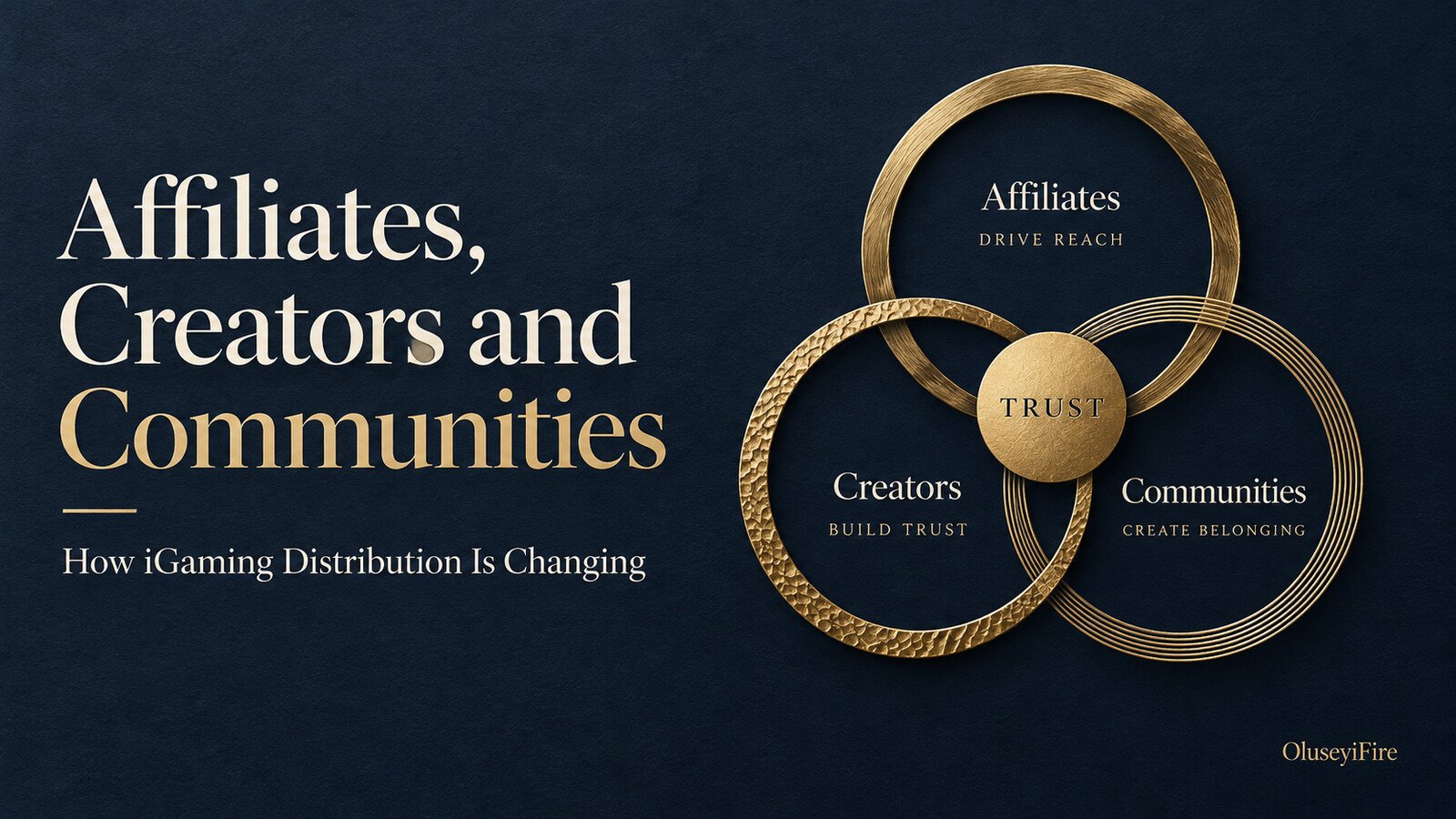
The traditional affiliate model assumes a relatively visible
journey.
A publisher attracts an audience, places a tracked link and sends
traffic to an operator. The platform records the click, registration and
qualified customer. Commercial value can be compared with reasonable
confidence.
That model still matters. It no longer describes the whole
distribution environment.
Customers increasingly discover and evaluate products through
creators, streamers, private messaging groups, tipster communities, peer
recommendations and local media relationships. The content may begin on
a public platform and continue inside a closed group. A trusted
administrator may interpret an offer before the customer ever clicks.
Several people may shape the decision while only the final touch
receives attribution.
This changes what an iGaming distribution strategy must
understand.
The task is no longer only to buy or reward traffic. It is to
identify how attention becomes trust, how trust becomes intent and how
the business can measure that journey without pretending every influence
is directly attributable.
My work across more than 100 active and local partner relationships
has included publishers, creators, streamers, media buyers, agencies and
messaging communities. I have also built international partner
intelligence covering more than 8,000 records across these categories.
The most useful lesson has not been that one channel is replacing
another. It is that partner roles are becoming harder to classify
through the old affiliate labels.
Selected case studies show how I apply this evidence standard across market, acquisition and partner-management work.
A creator can be an affiliate. A community can behave like a
publisher. A media brand can distribute through messaging platforms. A
performance partner can also create trust.
The operating model needs to reflect the function, not just the
label.
A strong iGaming distribution strategy classifies each relationship by function, evidence, audience ownership and commercial responsibility.
Distribution
is moving closer to trusted interpretation
Customers do not always need more information. They often need help
deciding which information to trust.
That is particularly relevant in markets where product claims are
difficult to verify, customer-service quality varies and formal
comparison infrastructure is still developing. A familiar voice or
community may reduce uncertainty more effectively than a polished
advertisement.
Closed and semi-closed groups can become a commercial trust layer.
Members see repeated interaction, observe how administrators respond to
questions and compare experiences with peers. The audience may perceive
the recommendation as part of an ongoing relationship rather than a
one-off placement.
This can create strong distribution. It also creates risk.
Trust can be used to explain products responsibly, or to amplify
misleading claims. Group administrators may promote offers without clear
commercial disclosure. Screenshots and testimonials can circulate
without context. Promotional urgency can spread faster than corrections.
Minors or vulnerable customers may be difficult to exclude.
The business cannot value the conversion benefit while ignoring how
the trust was created.
Classify partners by
function
Partner databases often use categories such as affiliate, influencer,
KOL, publisher, community and agency. These labels are inconsistent
across markets.
A more useful classification begins with the distribution
function.
Intent capture
Search publishers, comparison sites and some specialist content
properties reach customers already evaluating a product or offer.
Interpretation
Creators, reviewers, streamers and educators translate the product
into language and context their audience understands.
Trust transfer
A known individual, community or media brand lends credibility to an
unfamiliar proposition.
Repeated access
Messaging groups, subscriber channels and communities can reach the
same audience over time without depending entirely on public-platform
distribution.
Conversion facilitation
Some partners help customers navigate registration, payment or
product use. This can be valuable, but it requires clear boundaries
around data, identity, consent and account control.
Retention influence
Communities and content partners may keep customers engaged after
acquisition through information, events or shared experience. That
influence should not be confused with the operator’s responsibility for
the product relationship.
A single partner can perform several functions. Classifying them this
way helps the business design the right commercial model, evidence
requirements and controls.
Public reach
and owned access are different assets
A large following on a public platform can disappear from view when
an algorithm changes, an account is restricted or audience attention
moves.
A creator with a smaller direct community may have more durable
access. An SEO publisher may own discoverability through content and
ranking. A messaging administrator may have repeated access but limited
transparent reach data. An agency may aggregate many creators while
controlling little of the underlying audience.
Distribution assessment should examine:
- who owns the audience relationship;
- which platform controls access;
- how frequently the audience can be reached;
- whether engagement is public and verifiable;
- how the partner acquired members or followers;
- whether the audience matches the relevant market and age
criteria; - how commercial content is disclosed;
- what happens if the channel or account disappears.
Follower count does not answer these questions.
The business should also avoid treating a screenshot as proof of
audience quality. Public metrics, administrator evidence and
partner-reported data should carry different confidence levels. Tracked
customer performance can validate some claims, but even strong
conversion does not confirm that all promotional methods were
acceptable.
Communities create
attribution gaps
Closed distribution produces journeys that standard tracking cannot
fully observe.
A customer may see a post in a group, ask a peer for advice, search
the brand later and register directly. Another may copy a code without
using the original link. Links may be reposted across several groups.
Administrators may remove tracking parameters. Customers may move
between devices.
Last-click reporting will assign credit somewhere. That assignment is
not the same as a complete explanation of influence.
A practical measurement approach combines several evidence types:
- tracked links and referral codes;
- landing-page and registration-source questions;
- time-bound campaign and cohort analysis;
- market or community-specific offers where appropriate;
- partner posting records;
- incremental tests or matched comparisons;
- customer research;
- assisted-conversion reporting;
- repeated performance across defined periods.
Each method has limitations. Self-reported source data can be
incomplete. Codes can leak. Campaign timing can coincide with other
activity. Incremental tests may be difficult at small scale.
The objective is not perfect attribution. It is a defensible
confidence model that prevents the business from paying several parties
for the same unexplained outcome.
Commercial models
should follow the role
Forcing every creator or community into a standard CPA agreement can
distort behaviour.
A publisher capturing existing demand may fit performance-based
terms. A creator producing original educational content may require
compensation for production as well as outcomes. A community
administrator offering repeated distribution may prefer a fixed
placement, revenue share or hybrid arrangement. A media brand may bundle
content, events and access.
The commercial structure should reflect:
- the partner’s distribution function;
- evidence of audience ownership;
- content and production work;
- attribution confidence;
- expected customer value;
- regulatory and brand risk;
- the duration of the commitment;
- management and measurement effort.
Fixed fees should buy defined deliverables, not vague access.
Performance terms should use customer events that are measurable and
commercially meaningful. Revenue share should be understood as a
long-term commitment rather than an inexpensive alternative to upfront
cost.
The business should avoid paying twice for the same role without
realising it. An agency, creator and community administrator may all
appear in one distribution chain. The contract and reporting need to
show who delivered what.
Disclosure is part of trust
Some marketers worry that commercial disclosure will weaken a
recommendation. Hidden relationships create a deeper problem.
The United States Federal Trade Commission’s endorsement guidance
requires clear disclosure of material connections. The UK’s advertising
rules similarly expect affiliate marketing to be identifiable. Gambling
advertising standards add market-specific responsibilities around
accuracy, age protection and responsible promotion.
Disclosure should be understandable in the format where the promotion
appears. A statement buried in a profile, old message or long list of
tags may not make the relationship clear.
The operator and partner should agree:
- the wording and placement of disclosure;
- how it works in short-form and live content;
- how reposted material remains identifiable;
- which claims require evidence or approval;
- how age and market restrictions are applied;
- how corrections and removals are handled;
- what records must be retained.
Responsible influencer and community standards should not be treated
as a legal document sent after negotiation. They belong in partner
selection, briefing, creative review and monitoring.
Transparent promotion supports durable trust because the audience can
evaluate the recommendation with the commercial context visible.
Closed channels need
stronger governance
Private distribution is not beyond governance simply because it is
difficult to observe.
The business needs a proportionate method to verify placements and
monitor conduct without intruding on private conversations or collecting
unnecessary personal data.
Depending on the arrangement, evidence may include administrator
screenshots, post exports, approved test access, campaign logs,
timestamped creative, link reports and declared sub-channels. Legal and
privacy advice should shape what is appropriate.
Controls should cover:
- partner and administrator identity;
- group or channel ownership;
- audience eligibility and market relevance;
- approved claims and creative;
- commercial disclosure;
- prohibited direct messaging or scraping;
- handling of customer questions and complaints;
- personal-data boundaries;
- sub-affiliate or reposting rules;
- removal and escalation procedures.
The operator should not ask a community partner to collect sensitive
customer information or manage account access unless an authorised,
controlled process explicitly permits it.
The closer a partner moves to facilitating the customer journey, the
clearer those boundaries must become.
Community quality is
observable
Closed does not mean immeasurable.
Community quality can be assessed through operational signals without
claiming perfect knowledge of every member.
Useful signals include:
- consistency and relevance of discussion;
- proportion of original versus recycled content;
- administrator responsiveness;
- evidence of real questions and peer interaction;
- sudden membership or engagement spikes;
- alignment between declared and observed geography;
- promotional frequency;
- presence of misleading urgency or guaranteed-outcome claims;
- member complaints;
- downstream customer quality and support patterns.
The business should distinguish community health from short-term
conversion. Aggressive promotion may generate immediate activity while
degrading trust and increasing complaints.
Relationship review should include qualitative evidence from the
partner manager, not only tracked events. The review should also record
uncertainty. A team should be able to say that a source converts but
remains weakly understood.
That honesty is more valuable than false precision.
Build an iGaming distribution strategy as a portfolio
The changing channel landscape does not mean every business should
move into communities or creators.
It means the portfolio should reflect how customers in the target
market actually discover, evaluate and trust products.
A balanced view may include:
- high-intent search and comparison;
- creator-led interpretation;
- trusted local media;
- communities with repeated access;
- scalable paid distribution;
- direct customer relationships;
- retail or agent networks where relevant and lawful.
Leadership should examine concentration. If one messaging platform
changes policy, how much access disappears? If one creator relationship
ends, how much value is exposed? If search traffic falls, do other
channels create new demand or merely claim existing intent?
The portfolio should also show the role of each channel. Ten sources
performing the same function do not create the resilience of ten
distinct distribution capabilities.
Technology should preserve
context
This changing environment influenced the thinking behind TGPlug, a
venture focused on organising fragmented messaging-community and creator
intelligence into more usable commercial infrastructure.
The underlying problem is not a shortage of public handles. It is the
lack of structured context around ownership, market, audience,
verification, relationship history and performance.
Technology can help connect:
- partner entities and controlled properties;
- creators and the agencies representing them;
- public channels and related private communities;
- market and language coverage;
- verification evidence;
- commercial history;
- campaign placement records;
- tracked and assisted performance;
- compliance and risk status.
It should not pretend to make closed distribution fully visible. The
system’s role is to preserve what is known, label what is
partner-reported and show where confidence remains limited.
That is more useful than a large contact list that presents every
record as equally ready and reliable.
Distribution is becoming
relational
Affiliate marketing is not disappearing. Its boundaries are
widening.
Publishers, creators, media businesses and communities now overlap in
how they create customer intent. The most valuable partners may combine
content, trust and repeated access rather than delivering a simple
stream of trackable clicks.
This requires a more mature iGaming distribution strategy.
The business must understand the partner’s function, audience
ownership, commercial role and governance needs. It must measure
influence without inventing certainty. It must protect customers and
brand standards in spaces that are less visible. It must value trust
without exploiting it.
The commercial trust layer is real, but it is not automatically good.
Its value depends on how relationships are selected, disclosed,
monitored and connected to sustainable customer outcomes.
The next phase of distribution will not be won by the operator with
the longest partner list.
It will be won by the business that understands how local trust
moves, can work with it responsibly and can turn fragmented relationship
evidence into better decisions.